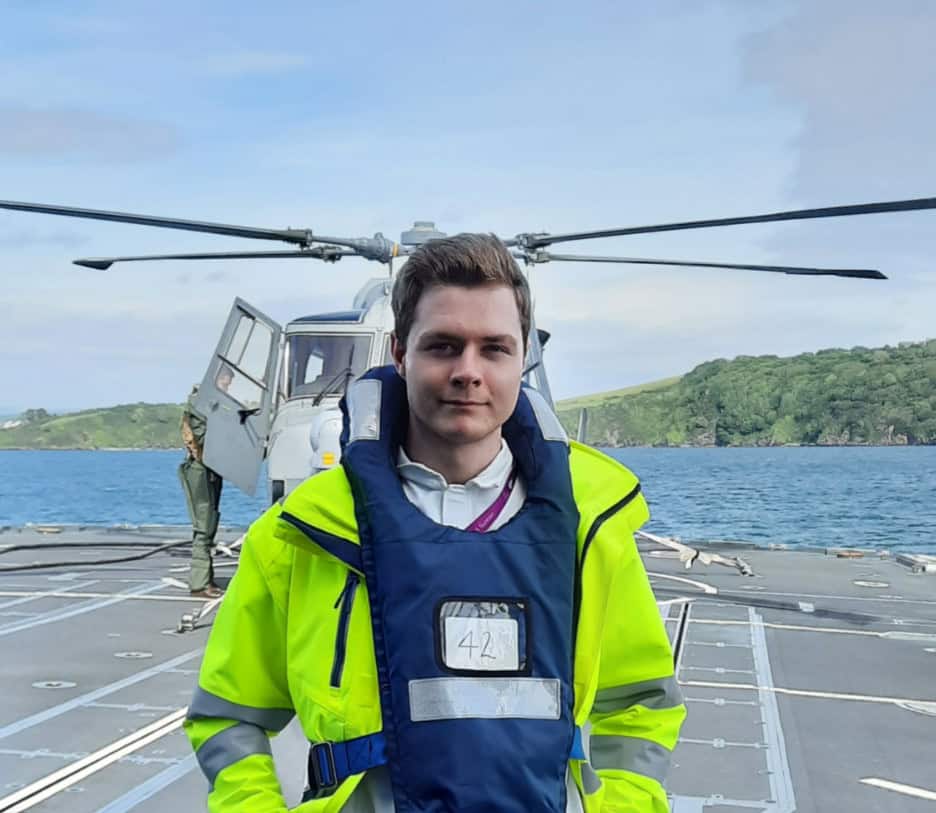
When Iain Hill decided a career with the Ministry of Defence (MoD) was for him, he was keen to make the most of the opportunities available to set him on the path to a bright future in maritime defence technology.
After completing an Apprenticeship with the MoD at Devonport Royal Dockyard and 18 months into his job in engineering management, Iain found that the wide variety of work on offer coupled with the opportunity to travel at home and abroad was an appealing mix. On being promoted, he set his mind on achieving Incorporated Engineer status and began looking for a Foundation Degree which would help him achieve that.
The answer lay at City College, and Iain is now in the third year of a Foundation Degree in Marine Autonomous Vehicles. The College had come recommended through his colleagues and he wanted to explore the learning opportunities and facilities – and loved what he found. As a Plymouth man, the location was spot-on and he knew other engineers in the Dockyard who sang the praises of what the College had to offer.
He’s quick to highlight the high standard of teaching at the College: “The lessons are excellent and you always feel support is there if you need it from people who have actually worked in the industry and you feel enabled to think critically and solve problems. The teaching is very good and the online resources are useful. As I travel a lot with my work, it’s really important to me that I can access so many of the lessons online and then come back with any questions if I have them.”
The Autonomous Vehicles Foundation Degree at City College is the only course of its kind in the UK. With autonomous and robotic vehicles firmly at the forefront of the future of marine science, the course uses a free-thinking and holistic approach to bring on the future workforce of blue tech industries. Iain’s work on the course involves looking at marine vehicles that can be pre-assigned with tasks so they can carry out operations independently. He has enjoyed the many elements including mathematics, science and programming, hydraulics and pneumatics as well as naval structure. “I have particularly enjoyed the coding, programming and software development side of things, as they are specifically for marine autonomy courses as opposed to marine engineering” adds Iain.
As a significant part of Iain’s Foundation Degree is ‘hands-on’ and practical, the College’s facilities are very important and he feels he has benefited from the state-of-the-art set-up including specialist labs and simulation suites. “One part of the course utilised industry CAD software to design, analyse and 3D print a bridge design with a focus on material strength to weight ratios. The facilities at the College are purpose-built for engineering so we had every single thing you could need.” Located in the heart of Britain’s Ocean City, the College also offers a unique setting for anyone interested in maritime careers. “Being right on the waterfront, with strong links to the Royal Navy and the wider defence sector, it really does feel like the ideal place to study something like this,” Iain adds.
Looking ahead, Iain feels the College experience has helped him grow his network of contents and knowledge, for example through regular events held in partnership with the Institute of Marine Engineering, Science and Technology. His advice to others considering the same path? “A few people I have worked with are going for the Foundation Degree. The MoD has been great with funding this for me so I’d say yes, you can do this, go for it!”